How TikTok and Instagram Reels Are Reshaping Camera and Lens Choices
Discover how TikTok and Instagram Reels are reshaping camera and lens choices for content creators in 2026, with gear recommendations and expert insights.
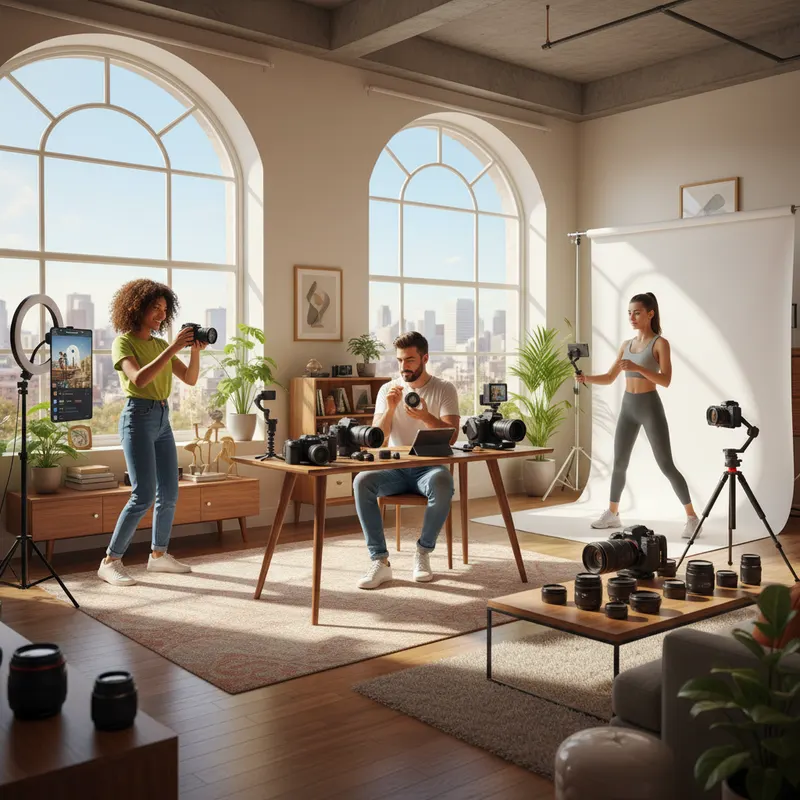
How TikTok and Instagram Reels Have Permanently Changed the Way Creators Think About Cameras and Lenses
If you’d approached a working photographer back in 2018 and suggested that vertical video would eventually drive camera sales and influence which lenses even get engineered, you’d have been met with genuine laughter. And yet here we are in 2026 — watching Sony, Canon, and Nikon quietly reconfigure their entire product pipelines around a format that arguably started with teenagers lip-syncing in their bedrooms. The short-form vertical video revolution didn’t announce itself politely. It showed up, rearranged the furniture, and the imaging industry is still figuring out where everything went.
What you’ll find below is a candid, thorough breakdown of how this format shift is rewriting the rules of gear selection, which products were genuinely built with the 9:16 world in mind, and where creators at every budget level should actually be directing their spending.
Portrait Orientation Isn’t Just a Phone Quirk Anymore — It’s an Industry Standard
Think back to the last time you actually rotated your phone sideways to watch something on social media. Can’t remember? That’s the point — because almost everything worth stopping for already arrives in portrait format. Data from Statista’s 2025 Global Social Media Report indicates that roughly 68% of all video consumed on smartphones now plays in 9:16 format, a remarkable leap from just 29% six years prior. TikTok crossed the 1.9 billion monthly active user mark in early 2026, and Instagram’s own internal numbers suggest Reels now accounts for more than a third of total session time across the platform.
These aren’t just impressive-sounding figures to throw around. They represent a genuine, structural shift in where audiences direct their attention — which naturally determines where creators need to point both their energy and their equipment budgets.
The Uncomfortable Truth About Horizontal Gear in a Vertical-First World
Here’s something most camera reviewers won’t say directly: the vast majority of cameras currently on the market were designed by engineers who never seriously considered vertical video as a use case. The ergonomics, the logic governing autofocus zones, the way image stabilization is tuned, even where the microphone sits — all of it presupposes a landscape orientation. Rotate one of these cameras 90 degrees on a gimbal and you’ll quickly discover how many invisible assumptions were embedded in the original design.
The problems compound fast. Autofocus systems that reliably place a face at the center of a horizontal frame often drift or hunt when the sensor is turned on its side, because the tracking zones were programmed around wide, landscape-oriented compositions. Image stabilization algorithms calibrated for horizontal panning movements behave strangely when vertical motion becomes the dominant axis. Wide-angle lenses that produce barely perceptible barrel distortion along the left and right edges of a landscape frame push that same distortion into the top and bottom of a portrait frame — right where viewers’ eyes naturally land on a talking-head video. And that shotgun microphone mounted to the cold shoe of your mirrorless body? It points straight ahead when you’re holding the camera upright, which is great. Rotate it 90 degrees for vertical shooting and congratulations — it’s now aimed at the ceiling.
None of this is impossible to work around. But every workaround adds friction to a solo-creator workflow that’s already demanding enough.
Manufacturers Are Scrambling to Catch Up — Some Faster Than Others
The imaging industry’s response to the vertical video era has been uneven at best — enthusiastic in its marketing language, slower in its actual engineering. Eighteen months ago, you’d have been hard-pressed to find TikTok or Reels mentioned anywhere on a major manufacturer’s product page. Today, “creator-focused” has become perhaps the most overused phrase in camera marketing. The commercial logic isn’t subtle: content creators as a group buy cameras, lenses, accessories, and upgrades at a rate that makes the traditional photography enthusiast market look modest by comparison.
Mirrorless Cameras Are Dominating Every Creator Segment
Across the board in 2026, mirrorless has firmly consolidated its lead. The reasons are familiar — smaller, lighter bodies that don’t punish solo handheld use, video autofocus that has genuinely surpassed what DSLRs ever achieved, and the ability to switch between photo and video without mechanical penalties. The real competition now happens entirely within the mirrorless category.
Here’s how the most relevant options stack up for creators right now:
| Camera | Max Video Resolution | AF System | Vertical Video Mode | Price (Body Only, USD) |
|---|---|---|---|---|
| Canon EOS R50 V | 4K/30fps (oversampled 6K) | Dual Pixel CMOS AF II | Native 9:16 mode | ~$699 |
| Sony ZV-E10 II | 4K/60fps | Phase-detect (759 points) | Software flip | ~$849 |
| Fujifilm X-M5 | 6.2K/30fps | Hybrid Phase/Contrast | Software flip | ~$799 |
| Nikon Z30 II | 4K/60fps | Hybrid AF (493 points) | Software flip | ~$749 |
| DJI Osmo Pocket 3 | 4K/120fps | Face/subject tracking | Native vertical | ~$519 |
The DJI Osmo Pocket 3 occupies a genuinely interesting position in this list. It’s not technically a mirrorless camera — but for creators whose output is exclusively short-form vertical content, it makes more practical sense than anything else here. The sensor is natively oriented for portrait shooting, subject tracking works without any rotation compromises, and setup overhead is essentially zero. You pick it up, point it at your face, and shoot. That kind of simplicity has real, tangible value when you’re posting every day.
The Canon R50 V, meanwhile, deserves recognition as a genuine turning point. It’s the first mirrorless body from a major manufacturer that doesn’t treat vertical video as a secondary consideration — the grip shape, the articulating screen, and the in-camera framing guides were all reconsidered for portrait orientation from the beginning of the design process.
Smartphones Haven’t Gone Anywhere — Be Honest About the Competition
Any genuine conversation about cameras for TikTok and Reels has to contend honestly with what smartphones are doing in 2026. The iPhone 16 Pro shoots Cinematic Mode footage at 4K/60fps with simulated rack-focus transitions that would have required a dedicated focus puller and a $15,000 cinema lens just five years ago. Samsung’s Galaxy S25 Ultra computational pipeline routinely produces cleaner shadow detail in auto mode than dedicated cameras operating under the same lighting conditions.
For creators whose main goal is posting consistently without investing hours in gear configuration, a flagship smartphone remains a formidable — sometimes superior — production tool. The dedicated camera argument holds on specific grounds: physically shallow depth-of-field from larger sensors, interchangeable optics for creative range, and audio integration that smartphone microphones genuinely can’t yet match. We’ve worked through this tradeoff carefully in our piece on Smartphone vs. Dedicated Camera: Is a Mirrorless or DSLR Still Worth It in 2026? — and the right answer depends heavily on what you’re actually making.
The Lens Market Has Been Completely Redrawn
Five years ago, the standard recommendation for a hybrid shooter starting out in the mirrorless world was a 24–70mm f/2.8 zoom. Versatile, optically strong, covered everything from portraits to landscapes. In 2026, that lens is increasingly beside the point for creators building a TikTok or Reels presence. The 9:16 format has pushed entirely different focal length priorities to the front of the conversation, and the lens market has responded accordingly.
Wide Primes Have Taken Over as the Creator Default
When you’re shooting vertical video in a bedroom, a small apartment kitchen, or a retail fitting room — which is where the overwhelming majority of lifestyle content actually gets made — a 70mm equivalent will frame roughly your forehead. A 16–24mm equivalent gives you breathing room to include the environment behind you, and that context matters more than most creators realize at first. Research into TikTok engagement patterns consistently finds that videos with readable, contextually interesting backgrounds hold viewer attention longer than sterile studio talking heads — because they give the eye more to work with.
The lenses that have risen to the top of creator recommendation threads in 2026:
- Sigma 16mm f/1.4 DC DN (APS-C) — approximately $329. Near-silent autofocus motor, minimal distortion even at the edges of a portrait frame, and optical performance from f/2 that genuinely competes with lenses at twice the price. This is the first lens I’d recommend to any APS-C creator shooting in tight spaces.
- Viltrox 23mm f/1.4 AF (APS-C) — approximately $199. The bokeh rendering at close focusing distances is cinematic for this price bracket. If your aesthetic leans toward shallow-focus beauty or fashion content, this lens embarrassingly outperforms what it costs.
- Canon RF 35mm f/1.8 Macro IS STM — approximately $449. The built-in optical stabilization produces a measurable difference in handheld vertical shots, and the close-focus capability opens up product and detail work that a 16mm simply can’t handle cleanly.
- Sony FE 20-60mm f/3.5-5.6 — approximately $548. For full-frame creators who need a single lens to handle both static talking-head pieces and mobile run-and-gun coverage, this compact zoom addresses more scenarios than any prime.
Autofocus Performance Has Flipped Creator Priorities Upside Down
One of the most counterintuitive shifts I’ve noticed across the creator community over the past couple of years is how dramatically autofocus consistency has displaced maximum aperture as the primary lens selection criterion. A survey of roughly 2,400 working content creators conducted by PetaPixel in late 2025 found that 61% cited “fast and consistent subject tracking” as their single most important lens characteristic. Maximum aperture landed at 19%, and raw optical resolution finished last at 14%.
Honestly? It makes complete sense once you consider the actual production reality. A solo creator has no one standing behind the camera to pull focus manually. An f/1.2 lens that hunts across a subject’s nose for half a second mid-monologue ruins the take. An f/1.8 lens that locks onto a face the moment it enters the frame and never lets go is worth significantly more in daily practice. The consequence has been a surge in demand for native-mount autofocus lenses — Sony E-mount, Canon RF, Nikon Z — even in cases where optically superior adapted glass exists at a lower price point. The autofocus integration that native mounts provide is simply too valuable to give up.
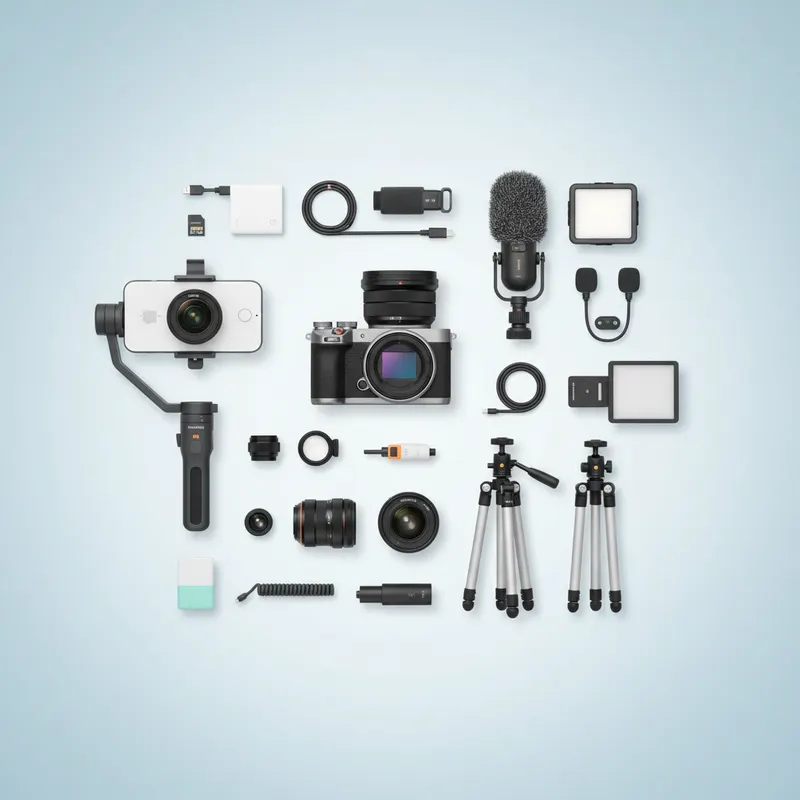
An Entire Accessory Ecosystem Has Quietly Reorganized Itself Around 9:16
Camera bodies and lenses get all the attention, but the vertical video revolution has generated a supporting ecosystem of hardware that barely existed three years ago. Overlooking this layer of the conversation is like evaluating a car purchase without considering where you’ll actually drive it.
Gimbals Rebuilt From the Orientation Up
The three-axis gimbal stabilizer was effectively perfected for horizontal video. Balancing a camera on a traditional gimbal for vertical shooting requires adapters, cage plates, and a working knowledge of counterbalance physics that most creators have no real interest in acquiring. The DJI OM 7, which arrived in Q1 2026 at around $179, ships with an integrated vertical hold mode that manages the physics automatically — select portrait orientation in the app and the gimbal handles the rest without additional hardware. DJI’s RS 4 Mini (~$269) extends this capability to lightweight mirrorless bodies under two kilograms, with a dedicated portrait tilt axis that produces genuinely smooth vertical tracking movements.
Cages and Cold Shoe Positions Reconsidered
SmallRig’s 2026 lineup introduced something that sounds mundane but solves a real daily frustration: camera cages with cold shoe mounting positions specifically mapped for portrait-orientation shooting. When a camera is rotated 90 degrees inside a standard cage, every accessory attachment point ends up wrong — the microphone faces sideways, the LED panel illuminates the wall beside you instead of your face, and cable management turns chaotic. Purpose-built portrait cages for the Canon R50 V and Sony ZV-E10 II eliminate these issues before they start.
Audio Integration Is Finally Catching Up
Audio has historically been the weakest link in the vertical video creator’s setup — not because quality microphones don’t exist, but because syncing wireless audio to camera metadata in a solo shooting environment carried more technical overhead than most people want to deal with. The Rode Wireless GO III, released in late 2025 at roughly $299 for the dual-channel kit, meaningfully addresses this by embedding timestamped metadata directly into the audio signal, which compatible Canon and Sony bodies can read natively. For a solo creator shooting multiple clips per session and editing under time pressure, the reduction in sync-related headaches is significant enough to justify the premium over earlier Rode wireless systems.
The Authenticity Problem That AI-Assisted Creation Has Created
The vertical video explosion has arrived alongside an equally rapid expansion in AI-powered creative tools — and the overlap between these two forces has produced a genuinely complicated situation for creators thinking about long-term audience relationships.
In-camera AI capabilities have become seriously impressive — real-time subject isolation, automatic skin smoothing, scene-adaptive exposure adjustments. Editing platforms offer AI-powered reframing that converts horizontal footage into a convincing vertical crop in seconds. At the same time, Adobe’s 2025 Content Authenticity Initiative survey found that 78% of consumers actively want disclosure when AI tools have been used to modify video content. The gap between what creators are currently doing with AI and what their audiences want to know about it is growing wider.
Camera manufacturers have started addressing this at the hardware level. Leica and Nikon were among the first to implement Content Credentials — a cryptographic metadata standard developed under the C2PA framework — that attaches a verifiable record of capture conditions to every video file. This metadata travels with the file through the editing and export process, theoretically allowing platforms to confirm that footage hasn’t been substantially altered from what the camera originally captured. As TikTok and Meta strengthen their AI-disclosure enforcement policies through the remainder of 2026, creators whose cameras produce C2PA-signed footage will carry a provable authenticity advantage that can translate into genuine, durable audience trust.
The deepfake implications reach well beyond individual creator reputations — we’ve examined how to detect manufactured imagery and video in our guide on Deepfake Photography and Camera Authenticity: How to Spot Fakes. And for creators curious about how AI is simultaneously improving legitimate in-camera capabilities, our feature on AI Photography Explained: How Artificial Intelligence is Enhancing Digital Cameras covers the full picture.
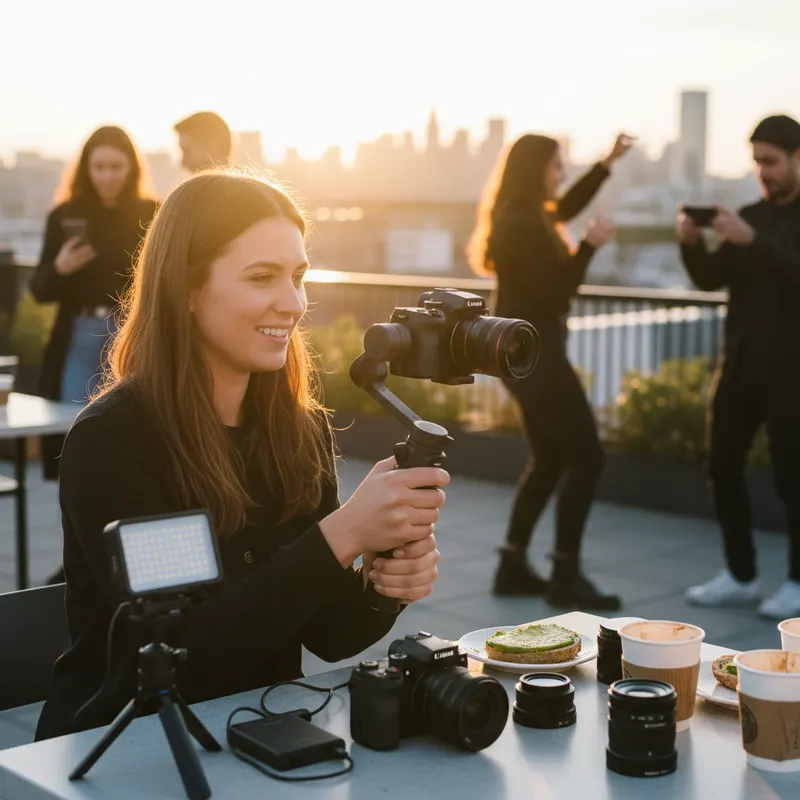
Gear Setups That Actually Reflect How Creators Work
Abstract gear discussions only carry you so far before they need to meet an actual niche and a real budget. Here’s a concrete breakdown organized around how creators genuinely operate day-to-day.
Solo Lifestyle and Talking-Head Creators
Creators working alone in this space need a camera that handles unattended autofocus reliably, audio that sounds professional without a dedicated sound person present, and a form factor compact enough to set up in a bedroom without rearranging the whole room.
- Camera: Canon EOS R50 V (
$699) for its native vertical mode, or the Sony ZV-E10 II ($849) for superior slow-motion headroom - Lens: Sigma 16mm f/1.4 DC DN (~$329) — wide enough for tight spaces, dependable enough to leave running unattended
- Audio: Rode Wireless GO III (~$299) dual-channel kit
- Stabilization: DJI OM 7 (~$179) for moving shots, a fluid-head tripod for stationary setups
Cinematic and Fashion Reels Creators
This category puts visual texture first — shallow depth of field, interesting color character, movement that feels considered rather than accidental. Budget can stretch further here because aesthetic quality directly drives follower growth.
- Camera: Fujifilm X-M5 (
$799) for its film simulation modes and 6.2K capture latitude, or the Sony A6700 ($1,399) for best-in-class APS-C autofocus performance - Lenses: Viltrox 23mm f/1.4 AF (
$199) for environmental and contextual shots, Canon RF 35mm f/1.8 Macro IS ($449) for close-up detail and product coverage - Stabilization: DJI RS 4 Mini (~$269) for tracking movements and dolly-style shots
- Lighting: Aputure MC Pro LED panel (~$149) for portable fill light that doesn’t require a full light stand setup
High-Volume Daily Creators Who Prioritize Speed
For creators posting multiple times per day — where time spent on setup directly limits total output — ergonomic simplicity beats technical ceiling every time.
- Camera: DJI Osmo Pocket 3 (~$519). Purpose-built for vertical, natively portrait-oriented sensor, face tracking that needs no configuration, and a body small enough to live in a jacket pocket.
- Audio: The Pocket 3’s built-in three-microphone array covers most scenarios adequately, supplemented by a Rode Wireless GO III for sit-down interview-style content
- Editing: DaVinci Resolve with platform-specific preset templates to cut per-video edit time down meaningfully
What All of This Actually Points Toward
The imaging industry has navigated format disruptions before — film to digital, mirrorless displacing DSLR — but the vertical video shift is different in one important way. Earlier transitions were driven by technology advancing the industry forward. This one was driven by audience behavior pulling the industry sideways in a direction nobody was prepared for. That reversal of causality matters, because it means manufacturers are still operating reactively rather than proactively.
That reactive posture will narrow through 2027. Manufacturers are now building vertical video requirements into product briefs from the very first design stage, rather than bolting them on as features after the main architecture is decided. Lens engineers are reconsidering distortion correction profiles specifically for portrait framing. Gimbal makers are including portrait-axis stabilization in entry-level products as a standard feature. Audio brands are deepening metadata integration with camera firmware across their entire lineup.
For creators making gear decisions right now, the practical conclusions are these: native-mount autofocus lenses are non-negotiable for solo shooting situations; cameras with genuine vertical video architecture — not just a software rotation trick — justify their price premiums in daily workflow efficiency; investments in audio and stabilization pay returns that optics alone can’t provide; and cameras with embedded content credentials are worth prioritizing as platform authenticity requirements continue to tighten.
The 9:16 format isn’t a trend waiting to reverse itself. It’s the primary visual language of social media in 2026, and every piece of gear in a creator’s kit deserves to be evaluated against that reality first.
Ready to find gear that actually fits your specific content style and budget? Browse our full range of camera guides and side-by-side comparisons at Digital Cameras Info — we update our recommendations as new products launch and real-world creator feedback accumulates.
You might also like

Best Cameras for Real Estate Photography in 2026
Find the best cameras for real estate photography in 2026. Compare full-frame picks for wide-angle interiors, HDR bracketing and dynamic range.
Best Budget Lenses for Sony A7 Cameras in 2026
Discover the best budget lenses for Sony A7 cameras in 2026, from affordable Sony FE primes to third-party Tamron, Sigma and Samyang E-mount glass.
AI Photography Explained: How Artificial Intelligence is Enhancing Digital Cameras
Discover how AI photography is transforming digital cameras in 2026 — from scene recognition to real-time noise reduction, enhancing every shot you take.